selçuksports taraftarium24 netspor canlı maç izle

Fifteen Years of Fantasma - Part Two

Part Two in a week-long, five part series celebrating the fifteenth anniversary of Cornelius’ musical masterpiece Fantasma. Read Part One — the introduction to the series as well as “The Age of Music Nerds.”

Part Two: Oyamada Keigo before Fantasma / Fantasma as an Album

Oyamada Keigo before Fantasma

Fantasma looms large in Oyamada Keigo’s legend. Before the album hit, he had already earned a place in Japanese musical history as a young prodigy and respected tastemaker. Through his first band Flipper’s Guitar, he became a god to Japan’s emerging class of indie kids from good families who wanted to indulge in culture that was distinct from society’s increasingly wealthy middle mass. He was not exactly an “underground” icon, however — he did ads for hair mousse brand Uno and thousands of girls in agnès b border shirts would faint at his presence. Upon exiting Flipper’s, he was rewarded with his own sub-label on Polystar called Trattoria that put out his friends’ bands and re-released forgotten Bill Wyman albums no one would be expected to buy (people investing into your certainly-money losing ideas is a true mark of cachet.) Despite achieving this charmed life by his mid-20s, Oyamada still had not established any sort of timeless musical reputation. If Oyamada was a building, he was closer to an immaculately trendy café than a museum.

Flipper’s Guitar — Oyamada’s teenage band, formed with fellow indie prince Ozawa Kenji — had revolutionized the Japanese pop music scene in the very late 1980s by bringing obsessive referencing of unknown British indie bands into the heart of the mainstream market (titles such as “Goodbye, Our Pastels Badges”, “Colour Field,” ad nauseum). Never had Japanese pop music been exposed to such fringe Western influences. And once critics lumped Flipper’s Guitar together with like-minded bands Scha Dara Parr and Pizzicato Five under the crude rubric “Shibuya-kei,” Oyamada and Ozawa became gatekeepers themselves, able to open the door to dozens of more interesting bands who cribbed extensively from Western records known only to 5,000 people worldwide.

Over in Osaka and Western Japan, a truly underground culture had given birth to experimental bands like The Boredoms. Tokyo’s Shibuya-kei revolution, however, developed mostly as an offshoot of consumer culture, revolving around the previously mentioned hipster cachet of reference collection. The Flipper’s Guitar opus thus suffered the natural consequences of this approach: Oyamada and Ozawa were often more interested in rewriting their favorite old songs rather than creating anything that could stand on its own. On their final record Doctor Head’s World Tower — the title celebrating expertise on the Monkees’ 1968 psych-pop film Head — Flipper’s just flat out rerecorded Primal Scream’s “Loaded” as a lyric-heavy pop song called “The Quizmaster.” The vocal melody of Scream’s “Come Together” acted as the verse hook of “Groove Tube.” Track “Aquamarine” is a languid pastiche of My Bloody Valentine’s “Lose My Breath” that drags into the musical equivalent of an Unisom. Sure these timbres and winks were landmark for 1991 Japan (and it’s overall a great record), but Oyamada and Ozawa seemed to be gunning for the title “Kings of Record Store Snobbery” rather than wanting to be recognized as songwriters who pushed melodies into new trajectories and painted brand new sonic landscapes.

After Flipper’s Guitar break up in 1991, Oyamada Keigo spent time producing singles for belle Kahimi Karie and Pizzicato Five’s album Bossa Nova (see Oyamada dance in a fake moustache in their video). Around 1993, he finally rechristened himself “Cornelius,” inspired by a Planet of the Apes TV filmathon. (The same one that apparently inspired Nigo to call his brand A Bathing Ape.) Oyamada’s first album under this moniker, The First Question Award, took nearly three years after Flipper’s dissolved to hit shelves, and despite that distance, it generally felt like a relapse into his old band’s Camera Talk-era pop songs. That’s to say, Oyamada confused himself as a singer-songwriter despite not much track record for original songwriting nor a particularly dynamic voice. He also continued to believe that his “style” of songwriting meant rewriting his favorite songs. The final track “The Love Parade,” for example, is a wholesale and unabashed redo of Roger Nichols and Small Circle of Friends’ “Don’t Take Your Time.” Whether he was determined to sell lots of records to fashionable teens or he fell in way too close to Pizzicato Five’s Konishi Yasuharu, the first Cornelius album has not aged particularly well. The liner notes to the Fantasma remaster suggest that more people remember the T-shirts that came out to promote First Question Award than the music itself. And in hindsight, nothing on the album really foreshadows what would make up Cornelius’ peak output, except perhaps the Charlton Heston-inspired, spacey lounge house of “Back Door to Heaven.”

Cornelius’ next album 69/96 came out in 1995, with a marketing hype that suggested the Ape had a true epic on his hands. But despite moving to a tougher, rock-based sound, the album suffered again from Oyamada’s confusion of himself as a singer and songwriter. Strongly reacting against his previous incarnation as a beret-wearing, overly-pleasant, moussed-up soft rocker, Cornelius made the choice to photograph himself for the album wearing devil horns.

As an angry simian, Cornelius built 69/96 on giant rock riffs, distorted vocals, and sluggish songs (single “Moon Walk”). The overall effect is not particularly pleasant on the ears, but in the process, Oyamada stumbled upon a big idea: his diversity of musical knowledge could work to push his albums beyond a commercial necessity and into a rumination on the history of pop. In the course of 72-minutes, Cornelius hits doowop, AC/DC-esque FM radio rock, giant Sabbath-y heavy metal, Hawaiian ukelele, ‘60s sitar clichés, G. Love and Special Sauce-like blues harp over breakbeats, classical music, and the sound of waves crashing for a good ten minutes. He is, however, not able to bring these disparate elements into a tight narrative, and the album feels almost infinite in time. The references themselves are also generally mainstream and accessible, making the album feel like a “sell out” by someone who is too lost within the labyrinth of indie music obsession to truly sell out.

69/96 is an interesting mess, but comes off ultimately as an indulgent moment from a label boss who hasn’t found his raison d’être. There are two stand out tracks, however: the mellow bossa nova of “Brand New Season,” which was one of the few pre-Fantasma tracks to end up in the permanent Cornelius live repertoire, and the extra-terrestrial porn grooves of “Rock / 96,” somewhat hidden as second side filler. But he just couldn’t leave the album though without ripping off a classic track — leading to a rewrite of The Beach Boys’ “Little Pad” as the triumphant exit “World’s End Humming (Reprise in Hawaii).”

Both records did not necessarily live up to the cultural impact of Flipper’s Guitar, but neither damaged Cornelius’ god-like aura. 69/69 was near the top hundred of best selling albums in 1995, and his embrace of like-minded T-shirt brand A Bathing Ape helped propel the Ura-Harajuku label into fashion stardom. Oyamada commanded a massive fanbase and a roster of talented junior bands under his direction on Trattoria. He had everything a musician could ever want — other than a killer, moment-defining album.

Fantasma as an Album

The early edition of Cornelius’ third album Fantasma dropped on August 6, 1997, sporting a retro-psych orange-and-white cover and the cryptic titling, “performed by CORNELIUS produced by KEIGO OYAMADA” — splitting the self and alter ego into distinct labor units. Oyamada was 28 years old at the time, a bit older than the Beatles during Sgt. Pepper but generally a good age for churning out one’s best pop music. Trattoria and Polystar staged the album’s release as a pop cultural event complete with radio ads and a TV spot (both included in the remaster boxset DVD).

Just as with Sgt. Pepper, nothing better signals an “incredibly important musical moment” like a meta-concept album. Fantasma is not just a loose collection of songs, but an immaculately-sequenced set of tracks that bleed into, complement, and reference each other. The contrasts between tracks are as meaningful as the similarities. And unlike sonically holistic masterpieces like Radiohead’s Kid A or My Bloody Valentine’s Loveless, Cornelius maxes out the possible number of sounds, instruments, genres, and musical conventions that could be held in a single silicon disc. Yet a very tight internal logic brings these particular aural expressions together. Despite its extreme diversity, Fantasma is never random. Even the odd sound bursts and feedback drones are perfectly on theme. And like any good concept album, the intention is for a straight listen from the first song to the last, in order, no skipping. Oyamada told Tokion (#6, May/June 1998), “Fantasma is a kind of album that only has one entrance and one exit. That is, you can’t listen to if from the middle. It’s important for Fantasma to be listened to as a whole from start to end.”

If Fantasma is a concept album, then what exactly is the concept? Simply-put, Fantasma is an album about music itself — a tribute to how the very process of hardcore music nerd fandom and collection reference lead to creation and production. Almost every song title references the name of a band (Microdisney, The Music Machine, Clash, Count Five) or a previously-existing song (Primal Scream’s “Star Fruit Surf Rider”, The Beach Boys’ “God Only Knows”). And lyrics discuss Oyamada’s favorite tunes like The Jesus and Mary Chain’s “Just Like Honey.” On Fantasma, Oyamada does not just enact his normal musical protocol but makes a statement about his own artistic philosophy. Even the fancy production tricks appear to be about the act of using fancy production tricks than just employing them to produce a seamless or professional sound.

The emphasis on production and soundscape is further amplified by the general lack of meaningful lyrics throughout the work. Six of the 13 tracks have no lyrics or just rhythmically repetitive wordings. For the other half, Cornelius completely abandons standard pop music lyrical clichés, never touching upon love, heartbreak, etc. There is a palpable lack of human emotion and social relation. We get the story of a “New Music Machine” launched into space by NASA in 2010 that ends up falling apart. “Clash” is vaguely about seeing a band at a club, perhaps The Clash. “Star Fruit Surf Rider”’s lyrical world is somewhere between pot-induced daze and a Murakami Haruki-esque life of lonely wandering, where the only person Oyamada meets on the streets is a cat. In fact, all of the text presents a narrative of solitude — listening to music by yourself, walking around by yourself, humming “Just Like Honey” to yourself. “God Only Knows” contains a solipsistic paradox where Oyamada can believe “I was the only one in the world / who caught a cold.” This all comes together to re-emphasize the overarching, and slightly melancholy, theme of solitary musical collection and study. But more importantly, Cornelius’ de-emphasis of vocals and lyrics — which had historically been perhaps the weakest of his many musical talents — is what allows Fantasma to go far beyond his previous records.

In fact, Oyamada’s vocals feel completely absent for the first burst of the album. The froggy-voiced “Mic Check” itself is oddly credited to Fujiwara Kazumichi rather than the Ape, but even if it is Oyamada who uttered those words, you never hear the former singer-songwriter “sing” anything until the song’s final loops of the word “start” harmonized into a tense chord which resolves into the luscious harp that will become the next track “The Micro Disneycal World Tour.” Oyamada never really takes the lead vocalist helm until the third track “New Music Machine.” Compared with his own oeuvre and that of his closest peers, this was a radical move for Cornelius. With Fantasma, he moved the entire Shibuya-kei needle closer towards experimental peers Buffalo Daughter and future wife Minekawa Takako, and away from the lyrical pop of Love Tambourines and Pizzicato Five. And moreover this was a public burial for any lingering vestiges of Flipper’s Guitar.

In keeping with the idea of music as a lonely pursuit, the album is also meant to be enjoyed in headphones rather than on speakers (or DJ’d at a club). This is explicitly explained on the “Fantasma spot” radio ad as well as hinted to with the special release of the album that included earbuds and came with a sticker that read “Album of the Ear.” Despite this directive for close listening, the album does not indulge in “micro-sounds” per se. Fantasma is wholly dynamic and ear-piercing throughout — with a healthy smattering of giant synth twinkles as if we are to exclaim “my god it’s full of stars” every five minutes. The emphasis on headphones, however, allows Cornelius to express his vision in the emphasis of individual instrumental parts, fragments, and production decisions rather than a general “blend” of sound coming out of speakers to complement and bolster an underlying song. The liner notes to the remaster (written up by Citrus’ Emori Takeaki) mention several times the idea of Fantasma as a “Rube Goldberg machine” — with many moving parts and always on the possible brink of disaster. The headphones give the listener a chance therefore to enjoy the tension between the individual modules performing and the successful race to the end of the track.

Since Cornelius is often referred to as the “Japanese Beck,” we should note here that Beck’s landmark Odelay came out almost exactly a year before, on June 16, 1996. Both Fantasma and Odelay can easily be seen as the two of the greatest late ‘90s records and harbingers for where the rest of the decade would take indie music in its flee from the earnestness of grunge and lo-fi. Sure there is a “Lord Only Knows” on Odelay and a “God Only Knows” on Fantasma, but both are just throwaway Beach Boys references rather than Cornelius’ contemporary borrowing of Beck. (Oyamada had already sampled “God Only Knows” back in 1991 quite prominently on the Flipper’s Guitar track “Dolphin Song.”) The albums otherwise have almost nothing to do with each other. Odelay is a classic American pop record built from loopy breaks and samples but ultimately lyrical and melodic. There is pastiche of ‘60s soft rock, old-school hip-hop, and Exile-era Rolling Stones, but always appropriated with irony.

As we will see below, Fantasma is a much deeper step into the abyss, almost totally abandoning the notion of songs and pushing pastiche so hard that it becomes completely denatured. And as I stated before, Oyamada had established his reference-heavy pop style long before Beck had committed his early weirdo folk grumblings to cassette. Clearly the two men found a kinship once Cornelius went international, but saying that Cornelius “was inspired by Beck” does not adhere to the actual timeline. The closest thing to what Cornelius’ Beck rip-off would sound like is the scratches, synth bass, funk horns, and break-beats of Fantasma outtake “Taylor,” which notably did not make it on the album. And Fantasma, despite its use of tools from electronic and hip-hop music, almost never makes explicit reference to African-American music like Mr. Campbell/Hansen. Cornelius’ drum ’n’ bass is chaotic Futurist noise rather than rasta-inflected jungle.

Next time: Fantasma, Track by Track

W. David MARX
September 11, 2012

W. David Marx (Marxy) — Tokyo-based writer and musician — is the founder and chief editor of Néojaponisme.

Fifteen Years of Fantasma - Part One

A week-long, five part series celebrating the fifteenth anniversary of Cornelius’ landmark album Fantasma.

On September 10, 1997, indie rock godfather and ultimate music nerd Oyamada Keigo (小山田圭吾) released the third album for his solo project CorneliusFantasma. The album endeavored to be unlike any other in the history of music, taking dozens of genres, references, samples, instruments, and sounds from familiar and unfamiliar sources and fusing them into a completely new sonic world. He succeeded wildly. The album sold extremely well to Cornelius’ long-standing fan base in Japan, and Matador Records in New York released it in the U.S. and Europe to international critical acclaim. Fantasma elevated Oyamada from fashionable pop star to certified musical genius, from domestic icon to global symbol of Japanese creativity. If not for Fantasma, Cornelius would not have remixed global stars like Beck and Sting, become a de facto part of Y.M.O.’s touring band, gigged with Yoko Ono, or collaborated with greats like Arto Lindsay. Fantasma etched Oyamada Keigo’s name into music history and guaranteed that the quirky Shibuya-kei musical scene in Japan would be forever perceived as a legitimate artistic explosion.

In 2010, Warner Bros. Japan — Fantasma’s post-Polystar master rights holder — decided to celebrate Oyamada’s fin de siècle magnum opus with a shiny new mastering job and a box-set re-release (unboxing video). There is not much to say about the remaster itself. Shibuya-kei electronica icon and close Oyamada friend Sunahara Yoshinori gave the recording a thicker bass while keeping the overall volume levels nearly equal to the original. (And for some odd reason the track splits have been relocated for a few songs, at least compared to the Matador release.) This technical aspect is, however, the least important point. The remaster further canonized the album in a national music culture where it is often taboo to award some records historical legacy over others. But if there is a Japanese album to receive the implied veneration of ceremonial re-release, it is certainly Fantasma.

Now at the 15th anniversary of Fantasma’s wide release, we will spend the next few days examining where the album fits within the canon of indie music both in Japan and worldwide, and re-explore it in the context of the decade and a half since its release.

Special thanks to Benny and Connor at Yikes, as well as Ryan Erik Williams and Suzannah Tartan for helping me dot the i’s and cross the t’s.

Part One: The Age of Music Nerds

Since at least the days of Bach and baroque, there have always been music fans and music experts, but not always “music nerds” — arguably a distinct product of late 20th century society. The music nerd is a specific yet now common type of pop music obsessive suffering equally from snobbery and consumerist zeal. They are different from “music aficionados,” who sat in velvet armchairs and enjoyed Beethoven on gramophones, or later, snuck underground to find the most outré forms of jazz in dark New York clubs. The music nerds started to pop up after the introduction of rock’n’roll, when music moved into a popular and explicitly commercial product form. While the old-school Schoenberg snob was an eccentric by his hobby alone, the music nerd was mostly eccentric inside the walls of popular genres and extremely crowded consumer markets. In other words, the nerd strived for personal uniqueness by discovering obscure objects within mass culture rather than beyond it.

The music nerd’s mission often boiled down to listening to what others did not, thus upsetting one of the art’s fundamental tenets. From ancient bone flutes to West African drum circles to jazz cafés to dancing the Charleston in front of blaring Big Bands, music had been a group activity for most of its existence. Music had always been social, yet the music nerd now mostly enjoyed it as a solitary pursuit. Hearing a song in the privacy of one’s own room was not even possible until the early 20th century, and not particularly common until the advent of the small transistor radio, the personal stereo, automobile speakers, and the Walkman. So between this technological change and a corresponding social one wherein pop music rolled over elite musical art forms like opera or ballet, the ingredients were there for the spontaneous genesis of thousands of music nerds. And as music fragmented to an unbelievable degree in the 1980s and 1990s, music nerds became even more intense and even less social.

The music nerd’s deep entrenchment into the collection of obscure albums transformed music from an innocent enjoyment of organized sound into competitive knowledge collection. Music became a form of proto-Pokemon. When two music nerds met, they did not dance together nor sit back and enjoy a mutual passion. Musical dialogue descended into the regurgitation of trivia and long strings of signifiers. Reference became the most valuable currency.

Yet much like the newspaper business and Penthouse magazine, the very 20th-century glass bead game of music nerdism has been ruined by the Internet. Music is now too overly available. The consumerist drive at heart of pop music has deteriorated. The Internet has made every single album of all time available — for free — to anyone who knows how to type the words Rapidshare or Mediafire. Meanwhile Wikipedia provides the Cliff Notes for faking the kind of deep musical knowledge once passed among music fans in strange cant. Nothing can really be “obscure” anymore. Information hyperinflation has wrought the music reference currency worthless.

In hindsight, this collapse of the music market means that the Nineties was the peak of music nerdism. At this time, globalization and technology had reached an ideal level of development for music and music criticism to ramp up the reference game. But there was not yet too much access to render the whole game obsolete. This was conveniently concurrent with the rise of hip hop in mainstream culture, and its backbone of sampling provided one of the greatest canvases known to man for exploring musical reference. By the mid-1990s and the end of primitivist Grunge, the obsession with reference also took over the mostly white “alternative” and indie music, a form most notably explored by Beck, the Beastie Boys, and Stereolab.

There was one other location, however, where it was even more natural for artists to boil down music to its atomic structure of signifiers: Japan. There may be traditional aspects of national philosophy and educational theory that influenced Japanese pop culture’s particularly obsessive mode of learning and understanding, but the artistic practice of detailed study and imitation of form certainly reached its peak with consumer society’s insatiable interest in the West after the War. Youth wanted to do completely alien things like dress like Americans and listen to American music, and magazines had to take up the key role of explaining detail by detail exactly how and why to do such a thing. Holistic sub-cultures like Hippies and Punks got analyzed down to their respective quarks so that Japanese teens could build them back up again from a bunch of imported scraps. These days the otaku nerd gets all the credit for originating Japanese information obsession but this was just a structural outcome of the Japanese model of cultural importation. In the act of bringing one culture over to another, bit by bit, every single possible cultural category becomes a series of consumable lists, and as a logical extension, mastery and memorization of those lists ends up as the most worthy test of true fans, believers, and adherents.

So in the 1990s, what is essentially “signifier music” was at its peak among the international elite, and with Japan’s natural predilection for understanding culture as units of signifiers, we could expect that the global genre’s most greatest creative expressions would come from Japan. And many years before Beck won over Americans with his folk-hop “Loser” anthem, an entire school of music revolving around pastiche, bricolage, sampling, and reference — Shibuya-kei — was already massively popular in its home country. Japan had an edge on this sample and signifier-based pop sound, and therefore it only made sense that the very best Shibuya-kei record would be primed to win the world championship of this wider genre. That record happened to be Fantasma.

Next time: Oyamada before Fantasma and Fantasma as an Album.

W. David MARX
September 10, 2012

W. David Marx (Marxy) — Tokyo-based writer and musician — is the founder and chief editor of Néojaponisme.

Candid Thoughts on the 2020 Olympic Logo

Train ads and posters are popping up in Tokyo advertising the city’s aspiration to host the 2020 Olympic Games. Adorning the posters is one of the most unimaginative logo designs of recent years, and as expected, a retrograde return to the expected visual formula for Olympics after the hard left turn that was the branding of the London 2012 Olympics. (Logo pictured above – also, hover over the images for the first full-color graphics on Néojaponisme to date.1)

The website promoting Tokyo’s candidacy as the 2020 Olympic city says this about the proposed logo:

The logo comprises an arrangement of cherry blossoms, Japan’s most celebrated flower, and supports the efforts of Tokyo as its bid to host the 2020 Olympic and Paralympic Games. The logo has been designed to symbolise the concepts of friendship and peace, and the floral motif expresses the feelings of deep gratitude inherent in Japan’s sending of cherry blossom trees to all parts of the world.

In addition to the Olympic colours of red, blue, yellow and green, the design incorporates the traditional Japanese Edo purple, a colour that featured prominently in cultural festivals, events, etc. in Japan’s Edo period (1603-1867). Each individual petal and the circular wreath shape of cherry blossoms represent the interconnectivity and interdependence of the world.

As the wreath has no beginning and no end, the logo also signifies the concepts of eternity, happiness and a continuous unbroken cycle. The design also embodies the strength of feeling that underpins Tokyo’s bid to bring the Olympic and Paralympic Games back to Japan for the first time since 1964, and the firm conviction that the Games will serve as a catalyst for the reinvigoration and regeneration of the whole of Japan.

The logo was designed by Ai Shimamine, a Japanese student in a competition to submit logo designs for the bid. Her winning entry was selected by a panel of judges comprising Tokyo 2020 CEO Masato Mizuno, award-winning designer Kashiwa Sato, and leading script writer Kundo Koyama.

While the branding is described as such on the website, how it is being used in public has a bit of a twist — the posters and train ads (one pictured below) include the five Olympic rings as well. In essence, the logo, an obvious conflation of the Olympic rings and the hinomaru2 with a decorative treatment of randomly colored sakura vector illustrations, needed the visual components spelled out for the public, as the mark itself isn’t a stable enough signifier on its own.

Being a product of student design work, it’s worth critiquing this logo as being exemplary of the type of lazy graphic design education standards that are currently upheld in much of Japan’s design university curricula.

1. Lazy type
The logo uses DIN, one of the world’s most non-offensive typefaces, then mimics the type treatment of Kamekura Yusaku’s 1964 Olympic logo placement of the hinomaru between the “Tokyo” and the year. To some, it’s perhaps a nod to history, though I’d reckon it’s just an easy, unimaginative swipe.

2. Hamburger Hot Dog
The conflation of sakura cherry blossoms (sure, sakura are fine when they are in bloom and are a widely acknowledged symbol of Japan) and the color treatment of Olympic colors along with the distinctly non-Edo era-evocative purple are exemplary of weak conceptual thinking and the most obvious “visual solution” applied, then bolstered by the application of another weak “concept.”

I refer to this type of design as a “hamburger hot dog” — two distinctly obvious choices forced together (or, more colloquially, the inverse of peanut butter and chocolate: two great tastes that absolutely don’t go together). I get hit with this kind of thing weekly on the critique wall in my graphic design classes at Temple University Japan and insist that my students start over each time. The Modern age of “The Big Idea” in graphic design is over, but moreover, when you take what someone purports to be a Big Idea, but is actually a fairly Small Idea, and then apply an even Smaller Idea to attempt to reify your attempt at a Big Idea, and all you wind up with is visual and conceptual mud.

3. Pizza Pizza Pizza
The rings plus the circle plus the wreath is the visual equivalent of saying the same thing three times in a row.

4. Cabbage Topping
Somehow a little cabbage got tucked into the top of the logo, as well. (I understand that it’s supposed to be a sakura bud, but it just looks like a cabbage, or at the very best, a brussel sprout.)

5. Spec Work
I hate design competitions, and moreover, I hate student design competitions. Sure, it may help that student get a job after school, but design competitions are a form of speculative labor. We don’t participate in design competitions with my design studio4, and I actively encourage my students to not participate in design competitions, as well. School should be a time for exploration and experimenting in the laboratory, not aping market rules, visual trends, and reductive thinking. Why can’t the Tokyo Olympic committee afford to pay someone for something that is going to make them a lot of money whether Tokyo wins the bid or not?

6. Y-A-W-N
As inflammatory as it is, Wolff Olins’ design for the London 2012 Olympics constituted an about-face on the typical “easy on the eyes” variety of graphic design and branding schlock that has been continually foisted upon the Olympic games. The London branding was divisive and engaging, and in that way, embodies so much of what the Olympics are about: They are a series of true competitions, not mere visual coddling and cheap ethnic variations of the same theme. I am a fan of design that challenges — and London’s branding did. The proposed Tokyo Olympic branding most certainly does not. It has neither the visual complexity nor conceptual depth/ambiguity to sustain multiple viewings.

Summary:
All in all, there’s just not a whole lot to grab on to visually or semiotically5. The 2020 Candidate City logo is all surface, but one that isn’t slick enough to sustain. It feels like repetitive clip art and weak themes (not concepts6) taken to their too-logical conclusion.

Craft-wise, the symbol feels amateurishly executed and displays a frightening lack of adeptness at the contemporary tools of design (notably the designer’s inability to correctly draw vectors in Illustrator — if design educators cannot teach students how to handle design-oriented thinking, they should at the very least be able to impart craft and correct practices in designing).

Most of all, I worry that I’m going to have to be stuck looking at this thing over and over again for the next eight years7. Train rides are mundane enough, but even a bit of recurring engaging graphic design makes each ride just that much better.

1 You’re welcome, Alin.

2 Also known as a circle.

3 Shimamine is a student at Joshibi.

4 I was approached regarding a speculative project this week for a non-profit, who insisted that it was 100% acceptable to, in essence, donate a day of my time to provide them with a free stab at their home page redesign. My response paraphrased:

“I’m sorry, but we cannot work for free. I have to set precedents, hence our not-working-with-Third-World-contractors policy and our not-doing-spec-work policy. Absolutely nothing good comes out of these situations — you’ll get a rushed design (which still takes hours of labor on our end) and we start our professional relationship in a non-professional manner which will have repercussions later.
We staunchly refuse to work spec because it means that:
A. The (not-quite-a-)client doesn’t understand that design is more than cultural hairdressing.
B. It sets a precedent for an unprofessional financial relationship. I don’t ask my clients for handouts, why is it acceptable the other way ’round?
C. There are no guarantees. I bet that if we agreed and did it, your company wouldn’t match our proposed budget after we provided the first round for free.
To be frank, if you proceed with a design/development studio that agrees to spec work, I bet you’re going to be disappointed in the future. Professionals act professionally and those that take on spec labor are usually the least professional in terms of output.”

5 The logo is not a visual metaphor, metonym, simile or anything truly thoughtful. In the end, it’s a ring of flowers that apes the look of the Unilever logo and other contemporary modular logos without the thought involved.

6 One of the most angering things about graphic design education in Japan is the confusion of themes, style and concept — one is not the other; however educators rarely, if ever, take the time to explain this in either the historical context or the contemporary one. Concepts can be executed stylishly, a la Robert Brownjohn and Barney Bubbles, however most design faculty in Japan tend to gloss over the finer points of conceptual thinking in an applied setting. Mere surface style is served up as a substitute for a balance of form and concept in most Japanese design university classroom settings. Even worse, style is discussed inadequately, leading to the current generation of Japanese graphic designers being unable to either make holistic work, much less talk about it. (The point: Graphic design education in Japan stinks and needs a real boot to the tuckus.)

7 An analogue can be found in issue #19 of Slanted Magazine within the section titled “Japanese Graphic Design: Not In Production” in which I wrote about Zombie Modernism 2.0 and my desire for ambiguity and contradiction in graphic design, not simplistic formula-based design.

The section functions as an overview of contemporary critical graphic design in Japan and as a critique of the myopic tendencies of the current American graphic design retrospective Graphic Design: Now In Production.

Ian LYNAM
September 5, 2012

Ian Lynam is a graphic designer living in Tokyo and the art director of Neojaponisme. His website is located at ianlynam.com. His new book, Parallel Strokes, on the intersection of graffiti and typography is available now.

Two Views of the Shikoku Henro Pilgrimage

We ask two American writers Gideon Lewis-Kraus and Matthew Firestone what it was really like to walk the 88-temple-long henro pilgrimage route in Shikoku — and learn that foot comfort is the secret to success.

Tucked between the very end of Honshu and the top of Kyushu, Shikoku is the least traveled and least familiar major island of the Japanese archipelago. There are few famous sites or tourist attractions, and most guidebooks recommend the location as a way to “experience rural Japan.” Shikoku does, however, attract a constant stream of visitors every year to walk, bus, bike, or drive through its famed 88-temple Buddhist pilgrimage route.

While most pilgrams in modern times are retirees moving through the course easily with the aid of tour buses, we wanted to get a sense of what it was like to do the course by foot as a young explorer with modern travel expectations. So we caught up with two American writers who have turned their Shikoku foot journeys into books: literary memoirist Gideon Lewis-Kraus and former travel writer Matthew Firestone.

Gideon Lewis-Kraus

Buy on Amazon Gideon is the author of the 2012 memoir A Sense of Direction: Pilgrimage for the Restless and the Hopeful in which he recounts his personal experiences through three pilgrimages: El Camino del Santiago with fellow writer Tom Bissell, the Shikoku henro by himself, and the Rosh Hashana pilgrimage to Uman in Ukraine along with his father and brother.

Gideon walked the Shikoku henro on foot, without knowing much Japanese and seemingly surviving on a diet of combini onigiri.

Why did you decide to do the Shikoku Henro by foot?
I’d walked the Camino de Santiago by foot and never really considered doing the henro any other way. There was some brief talk about doing it the way most Japanese people do it — by bus, or apparently for some wealthy people by helicopter — but by the time I got to the point of leaving for Japan I knew that the book was going to be more personal than anthropological so there wasn’t really a question.

Did you wear the traditional garb?
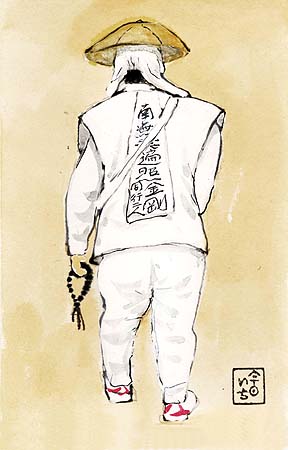
I wore the white pilgrim vest with the Heart Sutra inked on the back, yeah, because you really do need some indicator or you won’t get osettai (gifts locals give to the pilgrims). And after a few days you realize that trip is spectacularly taxing and the moments of real grace are mostly osettai-related.

I also had the traditional walking stick but halfway through I bought Nordic Walking Poles. I kept the traditional stick lashed to my bag, though. I didn’t wear any of the brightly colored sashes because they would’ve gotten dirty, and the traditional sedge hats don’t fit Western heads very well.

What is the average day-to-day on the pilgrimage look/feel like?
It varies quite a bit. There are days where you’re just walking through the run-down, rather dreary suburbs of cities like Tokushima or Takamatsu, and then there are days when you’re alone along the coast for long stretches. The flat parts are almost all along roads, and the traffic is jarring. The bits in the mountains are much more serene but, well, you’re going up and down mountains. It rains all the time, at least when I was there, in March and April.

How would you compare Shikoku to the rest of Japan?
Well, it’s hard for me to answer this question because Shikoku was the first place I ever visited in Japan. Now I’ve been all over the country and have a broader view, but my initial impressions were all formed in a vacuum. I suppose the answer is that it’s both. There’s some really stunning scenery, particularly in the southwest, between temples thirty-six and thirty-eight, but there’s also some pretty nontrivial squalor.

What was your ultimate fantasy of what you would get out of it?
The most honest answer to that question is that you probably have to read my book, but the easier answer is probably that I’d done this Western pilgrimage that was a line culminating in some supposedly climactic goal and had heard about the henro en route; the Japanese pilgrims who told me about it said that the circuit of the eighty-right temples was different because it was a circle, not a line. So I guess I had some vague ideas that maybe arriving where I’d started would provide an interesting sense of finality that I — and most other pilgrims — found wanting in anticlimactic Santiago de Compostela.

What is the harsh reality of doing the henro by foot?
Really, and this answer is always so banal, that it’s on asphalt. At the end of the henro, at this pilgrim welcome center between temples eighty-seven and eighty-eight, this guy asked me what the difference was between the Camino and the eighty-eight temples. There were a million things I might’ve said — that the Camino was social, and fun, for one — but I said that it was that the Camino was on these nice dirt paths. Your feet get used to the soft dirt in a way that they just never acclimate to the asphalt. I didn’t lose a single toenail on the Camino, and I lost three on Shikoku.

How much did you cheat? Was it worth it?
I cheated three times, but two of them were in places where you had to retrace your steps, which I thought was out of the spirit of the circle anyway. The first was the three kilometers downhill from temple twenty-seven; I’d twisted my ankle on the way up and needed to rest it. The second was about twelve kilometers between temples thirty-eight and thirty-nine, because it was pouring and I didn’t feel like walking back up the same road I’d walked down to Cape Ashizuri. And by then I was walking with an American guy who badly needed a break. The third time was when I took a train between temples sixty-four and sixty-five for about fifteen kilometers; that one vexed me considerably, and is treated at great length in the book. By then I had to get back to Osaka by a certain date for a party.

What was your greatest moment on the route?
That’s hard to say, because as much as I like to complain about the henro, there was a lot of it that I loved. The long stretch in the sun along the peninsula between temples thirty-six and thirty-seven, Yokonami Prefectural Natural Park, was just stunning and took place on the first day that my feet weren’t hurting in an urgent way. The walk through the inland woods between temples forty-four and forty-five was beautiful and I was with two young Japanese women I was very fond of. The summit of the mountain just above temple eighty-eight, obviously. And the whole last stretch, walking backward in the sun from temple ten to temple one, brought with it a whole welter of feelings about the six weeks I’d been on the circuit.

What was the nicest osettai a passerby gave to you?
This one lady gave me a little jelly pocket of this energy glop, and I was a little apprehensive about eating it, so I left it in my bag for a few days and remembered I had it at a perfect time. One of the Japanese women I describe above introduced herself to me with the osettai of an expired onigiri, and that ended up as a kind of inflection point on my trip. Another woman fished me out of the rain and gave me homemade miso soup and onigiri at a moment that, in retrospect, was probably critical morale-wise.

Do you think that you would have gotten more out of it had you been a Japanese speaker?
Oh, for sure. No question. The Camino is a ritual that you can just sort of parachute into and get a lot out of it. The eighty-eight temples are much harder to approach without some native resonance and familiarity.

Compared to your other pilgrimages, what was the sensation upon finishing it?
This is something I go into in great detail in the book so I’m not sure how to approach a short answer here, but I think a lot of my experience on Shikoku ended up being about pilgrimage as an evasion rather than as a quest. There’s something wonderfully and helpfully futile about the fact that ultimately you’ve just been running in a circle. There’s something quietly self-admonishing about the whole project, as opposed to the self-congratulation the Camino lends itself to.

Who would you recommend the henro to?
Japanese speakers. Japanese young people. People who fell so in love with the Camino that they need a bit of a corrective.

Your ultimate advice to someone planning to do it.
Don’t wear hiking boots; wear comfortable walking shoes. Nordic Walking Poles, for sure. Don’t go in March when it’s still really cold. Even though henro season starts March 1, I’d wait until April, or maybe do it in the fall. Get both the English-language guidebook and the Japanese one, as the latter has much better maps and is really useful even for non-Japanese speakers. Try to get lists of the zenkonyado and tsuyado in advance and have them translated if you don’t speak Japanese. Make reservations in advance if you’re staying in ryokan or minshuku, and ask at each place you stay where they recommend you stay the next night; the locals know the circuit really well and have a good sense for how far the next day should take you, and where a nice place to stay would be. You can have them call ahead to book you a room if you don’t speak Japanese. Plan for at the very least a day off in Kochi and a day off in Matsuyama. Get the katsuo bonito in Kochi and the grilled mochi at temple fifty-one, Ishiteji, in Matsuyama. Bring a poncho. Take the coastal road to Cape Ashizuri, not the highland route. Plan shorter days at the beginning and know that you’ll speed up later. And resist the temptation to feel like it’s all over after temple sixty-six, Unpenji, just because it’s the highest one; you’ve still got a ways to go. And, lastly, do not stay at any of the ryokan near temple seventy-five, Zentzuji. Those people are all crooks.

Matthew Firestone

Matthew Firestone is a former travel writer who co-authored 38 books for Lonely Planet and traveled to 85 countries. He currently lives in Tokyo, Japan.

Matthew completed the Shikoku henro by foot in 2007 on assignment for the travel guide Lonely Planet Japan 2007

Why did you decide to do the henro by foot?
In 2006 I was working as an author for Lonely Planet. I had just finished a lengthy stint in Botswana and Namibia when the henro gig landed in my inbox. It was a quick decision. I studied Japanese in university, and probably read a bit too much Basho for my own good. Plus I had both the time and the money to commit to a lengthy trek. A rare combination.

Did you wear the traditional garb?
No, but I’m rather particular about my travel gear. I was also hauling a pre-Macbook Air era notebook computer and an assortment of bulky and overpriced SLR equipment, so a proper rucksack and all-weather gear were non-negotiable.

What is the average day-to-day look/feel like?
There are infinite variables that will shape your individual experience, but the walking is constant.

How would you compare Shikoku to the rest of Japan?
By Japanese standards, Shikoku is a rural backwater suffering from systemic depopulation. The majority of towns and cities on the island are not very appealing to foreigners, even more so if you don’t speak Japanese. And Shikoku is arguably not as scenic as Hokkaido, hence the comparative lack of rural tourist infrastructure.

What was your ultimate fantasy of what you would get out of it?
My motivations were practical: submitting my manuscript on-time and under budget. But there were a few moments, largely induced by dehydration, where I envisioned myself to be an itinerant poet. Fortunately they didn’t last long.

What is the harsh reality of doing the henro by foot?
Blisters. Without going into the gory details, the henro brutalized my feet. Moleskin and neosporin helped to a certain extent, but I severely underestimated the crushing humidity and constant downpours of the Japanese summer. I opted for sturdy combat boots, but breathable, high-top sneakers would have made all the difference. There are also centipedes. And they bite.

How much did you cheat? Was it worth it?
A little bit. And no, it wasn’t.

What was your greatest moment on the route?
I have a soft spot for Dōgo Onsen, which inspired the visual design of the enchanted bathhouse in Spirited Away. A soak there makes you believe in the Ghiblii world.

What was the nicest osettai a passerby gave to you?
You tend to get a good mix of onigiri and omamori. A few times I received hip flasks of Japanese whiskey. The nicest osettai was an old pocket knife that was on its nth circumnavigation of Shikoku.

Do you think that you get more out of it as a fluent Japanese speaker?
Knowing a few key phrases and recognizing the kanji for place names will make your travels in Shikoku much easier. Being a fully fluent Japanese speaker obviously opens up doors. But there is no language requirement to complete the pilgrimage, nor obligation to share your time on the road with anyone else. To indulge in cliches, the henro is a journey of the self.

Compared to your other long travels, what was the sensation upon finishing it?
Equal parts exhaustion and elation, with a sprinkling of disbelief. This is a fairly standard reaction to finishing a trek. What differed was the restlessness that followed. “Miles walked” and “temples visited” are convenient metrics for measuring your days, but life isn’t always this easy to quantify.

Who would you recommend the henro to?
If you’ve read this much already, then you’re already a likely candidate.

Your ultimate advice to someone planning to do it.
Comfortable shoes, thick socks, and a good first aid kit. Entire armies have ground to a halt because of negligent foot care.

W. David MARX
June 26, 2012

W. David Marx (Marxy) — Tokyo-based writer and musician — is the founder and chief editor of Néojaponisme.

Dragged Out to Sea by a Shark

Matt Treyvaud reads through the stories from Kōdansha Bungei Bunko’s Contemporary Okinawan Literature: A Selection. First up, two-time Naoki Prize nominee Adachi Seiichirō

Introduction: I thought it might be fun to read through Kōdansha Bungei Bunko’s “Contemporary Okinawan Literature: A Selection” (現代沖縄文学作品選), because why not?

Dragged Out to Sea by a Shark by Adachi Seiichirō

Two-time Naoki Prize nominee Adachi Seiichirō’s Dragged Out to Sea by a Shark (鱶に曳きずられて沖へ) has the simplicity and brutality of myth. Set on a small fishing boat, “just before dawn” (夜明け前), its characters are initially identified only as an elder and a younger brother. Their conversation reveals bad blood over a woman, and within seven pages, one of them is dead.

Mishima Yukio’s The Sound of Waves (潮騒) was famously inspired by Longus’s Daphnis and Chloe, but Dragged feels closer to Japonic traditions. In the Man’yōshū (one of the poems of which was the source for Mishima’s title), boats tend to be viewed from a distance, preferably from atop a mountain far inland; they were useful as symbols of loneliness and demarcators of dominion’s edge, but the inner lives of those who operated them didn’t really come up. Adachi’s story, set at the edge of the modern state which traces its lineage back to the culture which wrote the Man’yōshū, takes us onto the boat and into the lives of its operators.

The elder brother reeled in the seventh rope with his right hand, looping the slack around his left forearm. The cold water dripping off the rope ran down his bare arms and dampened the thick black hair in his armpits.

“Nothing on this one either,” he said, clicking his tongue in disgust.

The younger brother jerked the oars violently …

But for all the shocking power of the story itself, the final lines feel awkward. The surviving brother had to yell something, I suppose, but did his words have to so artlessly reiterate what has already emerged so satisfactorily from the workings of the story itself? It feels like a cushion, dampening what should come as a terrific, uncompromising blow.

Further reading: Higa Minoru, 祟りなすものの南島的形象: 鱶伝説にみる南島の思想

Matt TREYVAUD
June 12, 2012

Matt Treyvaud is a writer and translator living near Kamakura. He is Néojaponisme's Literature/Language editor and the proprietor of No-sword.