selçuksports taraftarium24 netspor canlı maç izle

The History of the Gyaru - Part One

A three-part series on the famed Japanese female subculture and its the evolution from a summery look of rich delinquent high-schoolers to an extreme set of working class styles. [2019 Note: There was supposed to be a fourth part about the post-ganguro gyaru revival, but never got to it.]

Introduction

The Japanese understand their own history of street culture as a constant succession of youth “tribes” who dominate the landscape for a few years with a specific style and then disappear just as quickly as they arrived. The tribes were often useful as a human representation of the era’s zeitgeist — for example, the Futenzoku hippies in the late 1960s or the Bodicon girls of the Bubble era — but sometimes were not much more than historical quirks — e.g. the preppy Miyuki-zoku who only existed for a few short months in the Summer of 1964. Regardless, Japanese cultural taxonomy requires the tribes to quickly rise and fall as to make room for the next set.

With such expectations of ephemerality, what are we to make of the long-lived gyaru subculture? Starting in the early 1990s and hitting a new peak around 2010, gyaru have existed in one form or another for two decades. Although the style has changed dramatically multiple times and splintered into distinct factions, a few principles have remained stable: hair dyed anywhere between chestnut and deep blond, sexually-provocative clothing, an embrace of youth, chronic shopping in Shibuya 109, and a generally “wild” attitude.

Many have seen long-term gyaru dominance as a symptom of a depressed Japanese economy’s inability to invent and push new styles. Looking closely at the actual changes in fashion and cosmetics, however, the gyaru of 2012 look almost nothing like the gyaru of 2000 let alone those of 1992. Gyaru, in other words, have not actually been a single tribe or subculture, but instead, something like a “style stream” — with each incarnation influencing the next but radically changing along the way. The gyaru look has shifted from the relatively natural kogyaru schoolgirls of 1995 to the shocking ganguro of 2000 to the koakuma glamorous blondes of 2008. While very different, they all understood themselves as “gyaru” and were understood in wider society as “gyaru” as well.

This ability to evolve with the times may be the gyaru movement’s core strength, but the transformations have not simply been a superficial shift in fashion. Most critically, the class composition of gyaru has changed over time. Gyaru style started as a delinquent look for rich girls at top Tokyo private schools, but ended up as the new face of yankii non-urban working-class delinquent style, blending seamlessly into preferred aesthetic of kyabajō “women of the night.” The gyaru thus provide a perfect case study to understand how style in Japan often trickles down from the affluent to the middle classes through the mass media and then is co-opted and re-conceptualized by the working classes.

This four-part series attempts to look at the origin of gyaru style, the nature and mechanisms of its style changes, and the shifting social context of each historical stage. And hopefully these essays will clear up a few of myths surrounding gyaru along the way.

The Origin of the Kogyaru: 1991-1993

There is no exact date or even year when the gyaru first appeared on the streets of Shibuya. Their arrival was both gradual and unexpected. As former egg editor Yonehara Yasumasa told me in 2008, “The gyaru totally came out of nowhere.” But sometime in the early 1990s the nation began to notice a swarm of high school girls with brown hair, short schoolgirl skirts, and slightly tanned skin clutching European luxury bags and wearing Burberry scarves. And eventually they were known widely under the name kogyaru (コギャル).

In the past, most youth fashion tribes found their look by following instructions from the media. The Shibuya gyaru, on the other hand, were virtually sui generis — the fashion style just bubbled up organically from a few sources. Indeed, kogyaru culture was the grand culmination of four prominent late 1980s trends: namely, “gal” party girl culture, Shibuya’s rise as a fashion and nightlife spot, chiimaa party event organizer gangs, and schoolgirl uniform pride. This piece will examine what each of these streams contributed to the formation of kogyaru culture.

Note: Before the arrival of the kogyaru, the word “gyaru” (ギャル) represented a completely different segment of females, and while they are related, as I explain below, current gyaru culture should not be confused as a direct descendent of the pre-kogyaru version. In order to make a clear distinction, I use the English word “gal” for instances of ギャル in Japanese texts before kogyaru, and “gyaru” for anything after. This is admittedly an arbitrary difference in translation/transliteration and certainly there are no differences in the original Japanese words. Differentiation, however, is necessary to understand the nuance of the word’s contemporary usage.

The fun-loving gals

The word “gyaru” (ギャル) — a Japanese pronunciation of the English word “gal” — first entered the Japanese language in 1972 as a sub-brand of Wrangler jeans. After prominent mention in a 1979 Sawada Kenji song title, “gal” eventually came to designate young women who were highly socially active and relatively superficial (Namba 2006). Compared to the fussy, snobby ojōsama types from good families and always worrying about social protocol, the gal were easy-going and fun. In an 1989 survey uncovered by sociologist Namba Koji (2006), young women defined gals as “those who don’t care if their guy is from money or a good family; they go for trendy looks, clothing, behavior, and are cheerful.” In other words, gals were party girls.

In the 1980s, magazines like Gal’s Life, Carrot Gals, Popteen, Kids, and Elle Girl came to target and represent this gal sector, offering more salacious and realistic stories about teenage sex than one would find in upper middle-class consumerist lifestyle magazines like JJ, CanCam, and olive. While not explicitly based on yankii (i.e. non-urban, working class delinquent) aesthetics, the magazines did offer a more down-to-earth and inclusive view of Japanese teenagers that, unlike their more well-funded and prestigious rivals, did not constantly demand Japanese women reenact American and European lives. But when the Diet singled these magazines out for bad influence on youth in 1984, the “gal” became further stereotyped as sexually promiscuous, and the term took on generally negative connotations (Namba). Men’s magazines amplified this nuance by using gal to describe the young participants on the era’s sexually provocative TV shows All Night Fuji or Onyanko Club’s Yūyake Nyan Nyan.

As Japan entered the Bubble era, the term gal started to represent a specific consumer segment, mostly made of young office ladies (OLs). The gals were personified in the media as those wearing bodicon (“body conscious,” i.e. tight fitting) outfits and dancing on raised platforms at mega-disco Juliana’s. In 1993 journalist Yamane Kazuma wrote an entire book called The Structure of Gals that tried to explain and celebrate this new generation of women obsessed with the nouveau riche nightlife and wanton materialism. For most of society, however, the word “gal” became known as the party girls at discos, and from here we finally discover the direct link to modern day usage.

The term kogyaru — “ko” being either for “small” (小) or “child” (子) — is said to have started as jargon among bouncers to designate the high school girls who tried to sneak into clubs and look like their older peers. These “little gals” formed the core of the first modern gyaru movement, and even when the “ko” was dropped in later years, the term “gyaru” came to represent their descendants.

The rise of Shibuya as the fashion center

Shibuya is now famous as the birthplace and mecca of modern gyaru style, but the neighborhood was not always a breeding zone for Japanese fashion. As a commuter hub with ample options for entertainment and shopping, the area attracted lots of visitors throughout the post-war. Then when wealthy Baby Boomers began to construct new upper middle-class neighborhoods in Meguro, Setagaya-ku, and Suginami-ku on Tokyo’s West side, their teenage offspring gravitated towards Shibuya as the most convenient central urban location (Chimura). This influx solidified Shibuya as a hotspot for youth culture.

Harajuku had been the main youth fashion center for Tokyo since the 1970s, and from 1985 to 1988, national style centered around the “DC boom” for “designer and character” brands mostly located in the interconnected areas of Harajuku, Omotesando, and Aoyama. During this period, teens slavishly followed media advice from glossy fashion magazines, flocking to exclusive labels like Comme des Garçons and Y’s to buy highly-designed and avant-garde outfits.

The burgeoning generation of rich kids who hung out in Shibuya, however, spurned this designer-driven approach to fashion, preferring a laid-back preppy vibe. When the Harajuku fashion bubble collapsed in 1988 and the DC boom petered out, all eyes turned towards the emerging Shibuya style, which came to be known as shibukaji or “Shibuya Casual.” Suddenly every lifestyle magazine had forgotten the idea of high-concept fashion design and started singing the virtues of traditional basics like Polo Ralph Lauren navy blazers, Levi’s 501s, and loafers. The upscale Shibuya girls meanwhile carried Louis Vuitton and Chanel bags but in a casual and non-fussy way. The overall atmosphere was moneyed nonchalance — having the right, conservative brands but not looking like you actually paid attention to the fashion world. In the heady Bubble days of wealth accumulation and socially-condoned avarice, these wealthy kids convinced the nation’s young that they were the best style leaders around.

Soon, however, middle-class kids from across Japan became experts on shibukaji thanks to tutorials in magazines like Men’s Non•no or Hot Dog Press, and their influx into Shibuya brought organic changes to the look. The “American” influence quickly moved beyond classic East Coast staples and brought on ethnic, Native American, and West Coast influences as well. And with men, the style split into two camps — a kirekaji “clean” version, and a more rebellious look that mixed in silver jewelry, surfer influences, and a bit of Guns’n’Roses Sunset Strip edge. The latter became well-known as the signature look of “teamers” who started ruling over the neighborhood.

Teamers / Chiimaa

Starting in the late 1970s there had been a long-tradition of university clubs at top private schools holding intermural disco parties, often with the strong backing of the venues and even advertising sponsors (Arai 33). As Shibuya became the social destination for Tokyo youth in the late 1980s, elite college and high school students began to capitalize on the neighborhood’s popularity by throwing parties at Shibuya clubs. Events became branded as the latest party from regular “teams” of party throwers, and the kids in these groups became known as “teamers” — chiimaa, in Japanese. The team members generally came from affluent backgrounds but clearly had a delinquent streak as they were spending all their times organizing nearly-underground dance parties rather than hitting the books (Arai). When not party-organizing, they hung out in Center-gai — the main strip of Shibuya built up with fast food joints — or drove around in their cars roaming for girls.

All of this minor delinquency was generally tolerated until the chiimaa started finding themselves more and more involved in territorial clashes. The most violent members caused a series of notorious incidents from 1991 to 1992 that left a college student and a homeless man dead and put many others in the hospital. Law enforcement started to crackdown in response, and clubs became less lenient about underage party promoters. The entire chiimaa and Shibuya movement started to take on a highly negative reputation, and the parties themselves slid into oblivion.

The chiimaa were ultimately a temporary movement, now forgotten as a blip on the timeline of pop culture, but ironically, their girlfriends, who played little part in this male-dominated world, would be the ones with a lasting influence. The girls who grouped around chiimaa spent lots of time at tanning salons and baring their browned mid-riffs. They loved the style of Los Angeles and wore LA Gear sneakers. PARCO’s Across marketing guide ended up calling these girls paragyaru — gal who tried to maintain a “paradise” (i.e. beach-oriented) lifestyle all year round. The paragyaru were never a mainstream nor well-known subculture, but these they helped bubble up the surfer-girl elements that would come to mark kogyaru style (Namba 2006).

More importantly, the very first kogyaru were some of the younger girls in chiimaa circles. Former egg editor Yonehara describes the original kogyaru as “girls from Keio and other private high schools who hung out with the bad boys (chiimaa).” To wit: the first Shibuya kogyaru were essentially chiimaa girlfriends.

Schoolgirl uniforms reformed

The previous trends explain why rebellious girls in Shibuya preferred tanned skin, Louis Vuitton bags, and a slightly sexy approach to clothing, but the most important style innovation of the kogyaru was certainly their embrace of the schoolgirl uniform. In the subculture’s most stereotypical incarnation, the kogyaru wore a pleated plaid schoolgirl skirt hiked up to an extreme mini length, matched to standard issue weejun loafers and bulky white “loose socks.” The look mutually emphasized their bare thighs and young age, thus titillating the nation’s significant base of lecherous old men.

While most social analysis until now has fixed upon the kogyaru’s sexualized transformation of the uniform, it’s worth asking a more basic question: Why were trendy high school girls wearing their mandatory school clothes rather than changing into their own individual outfits?

In the early 1980s, high school girls were quick to abandon their sailor suits every day before heading out into the town, whether by choice or to comply with school rules. This essentially hid the fact that they were still high school students while they shopped or partied.

By the end of the decade, however, most of the top private schools in Tokyo started to face serious competition in light of declining birth rates (Across Editorial Desk 236). School boards came up with a grand solution: hire top designers to redesign the uniforms and make them more akin to modern fashion. Thus was born the School Identity (SI) movement, which took off nationwide around 1987 and saw schools dressing their young women in blazer-type ensembles rather than the traditional and slightly infantile sailor suit look (Namba 2006).

The students evidently loved the change and began to see their uniforms as a proud piece of personal clothing rather than mandatory attire (Across Editorial Desk 236). They then flocked to Shibuya in the afternoons or on weekends still wearing their school clothes, and this changed the overall look of the neighborhood’s fashion. But also, by wearing their uniforms, high school students were embracing their youth rather than hiding it. This streamlined into a general social trend — the “high school girl boom” (女子高生ブーム) — where the ideal age for a woman in Japan, both in women’s own estimations and in the male gaze, hovered around 16.

With most early kogyaru coming from the top private schools, the burgeoning subculture built upon the base of a well-designed school uniform and then added a few rebellious touches. Following the paragyaru’s summer-friendly style, they hiked up the skirts to make a knee-length dress into a mini-skirt. And the “loose socks” were another personalized touch, influenced by both American sport socks and kushu kushu socks from the French casual boom of 1992 (Namba 2006). In further defiance to authority, the kogyaru dyed their hair from rulebook black to a subtle reddish chestnut color known as chapatsu. They essentially took the best parts of the uniform and then broke it down to make it their own.

Interestingly school uniforms have always been the primary look for delinquent teens in Japan. The most famous example is the extra-high Prussian collar (gakuran) of yankii in the late 1970s. Working class delinquent girls of the past also openly violated their school’s uniform policy, but the sukeban girl would lengthen her skirt beyond the required hemline, rather than making it shorter. This actually took much more effort as you had to find matching materials and know how to sew.

Kogyaru on the other hand, in their affluent delinquent nonchalance, just hiked the whole thing up to give it both a light air of defiance as well as a nod to sexy Shibuya style. This small touch was easy to do but radical enough to give birth to what became known as kogyaru style.

The initial kogyaru were high-school girls partying in Shibuya with chiimaa boyfriends, adding summery style cues from older girls into their uniforms. While certainly “bad girls” in society’s eyes, the gyaru were well-to-do for the most part — attending private school and hanging out with other rich delinquent kids whose parents and pedigree would get them to a good college or job without much effort. What is also interesting is the fact that no magazine or media invented this look, but instead it grew organically within this small subculture of rich delinquent teens.

By 1993, there were enough kogyaru on the streets of Shibuya to notice a new “trend” but it was hardly a mass style. In the next installment we look at how the kogyaru became mediated in mass culture — moving seamlessly from sexual objectification to moral panic to nationwide fashion trend.

References:

Across Editorial Desk. Street Fashion 1945-1995. PARCO, 1995.

Arai, Yusuke. Gyaru to Gyaruo no Bunkajinruigaku. (The Cultural Anthropology of Gyaru and Gyaruo) Shincho Shinsho, 2004.

Chimura, Michio. Post-War Fashion Story 1945-2000. Heibonsha, 1989.

Namba, Koji. “Concerning Youth Subcultures in the Postwar Era, Vol. 5: ‘Ko-gal’ and ‘Urahara-kei,’” Kwansei Gakuin University Sociology Department #100, March 2006.

Namba, Koji. Sōkan no Shakaishi (The Social History of Debut Magazine Issues) Chikuma Shinsho, 2009.

W. David MARX
February 28, 2012

W. David Marx (Marxy) — Tokyo-based writer and musician — is the founder and chief editor of Néojaponisme.

The Japanese Diet vs. Popteen

On January 2, 1983, the Japanese Diet called upon the Japanese Magazine Publishers Association’s Ethics Committee Chairman for a frank chat about the conspicuous increase of sexual content in young women’s magazines. In particular legislators were concerned about Gal’s Life (Shufu no Tomosha), Kids (Gakushu Kenkyusha), Elle Teen (Kindai Eigasha), Popteen (Asuka Shinsha), Carrot Gals (Heiwa Shuppan), and Maru Maru Gals (Toen Shobo). These were relatively popular titles at the time, with Gal’s Life selling a half-million copies a month and Popteen right behind it at 350K.

The publishing industry did little in response, and so in February 1984, Mitsuzuka Hiroshi, the Deputy Chairman of the Liberal Democratic Party’s Policy Research Council, spoke out in the middle of the Lower House Budget Committee, complaining about the plague of explicit sexual articles in girls’ magazines, which he called “instructional classes on sex.” Mitsuzuka took the struggle from the Diet floor to the media, appearing on TV shows to further indict the publishers. Prime Minister Nakasone also weighed in: “There’s a worry that the sexual depictions in certain magazines for young women may lead to crime” and then hinted that he would be open to legislative or otherwise administrative action against the publishers.

Results were swift. The day after Mitsuzuka’s Diet speech, publishers Heiwa Shuppan and Gakushu Kenkyusha announced they would discontinue Carrot Gals and Kids, respectively. Gakushu Kenkyusha was in a particular bind as it had a huge business in another highly regulated field: educational text books. Popteen meanwhile pledged a new editorial direction. Gal’s Life changed its name to Gal’s City to escape the increasing social stigma and took out all the dirty articles. This was apparently not what readers wanted, however: Sales dropped so violently that Shufu no Tomosha put the title out to pasture one year later.

What was this sexual content that the Liberal Democratic Party were so concerned about? Essayist Sakai Junko remembers Gal’s Life as chock full of “juicy stories that covered the rawer parts of girls’ lifestyle.” Gal’s Life provided a stark contrast to Magazine House’s olive — a title that imagined all Japanese teenagers wanted to imitate the “good sense and elegance of Parisian lycéenne.” While digging through old issues of Gal’s Life, Sakai discovers these article headlines:

  • “Takada Namie’s Girl-Fight Dojo
  • “‘I’m sorry, baby’ — Abortion Experiences”
  • “The Exciting Vacation Before We Got Secretly Married”
  • I’m not a prostitute! The Lifestyle and Outlook of Miho, who works at a Shinjuku massage parlor”

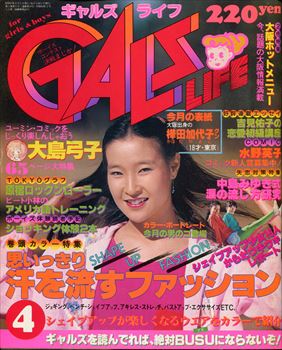
There are few images of Gal’s Life available online, and this cover from 1980 has much less controversial headlines (although it does sport the amusing promise “You won’t be an ugly girl (busu) if you read Gal’s Life!”) The general sense, however, is that the magazines had a constant stream of salacious articles for young women on sexual topics, all blanketed in a general atmosphere of “documentary” reporting.

In his book Sōkan no Shakaishi (The Social History of Debut Magazine Issues), sociologist Namba Koji mentions a few articles in Gal’s Life such as “Gal Sex Report”, “Document: Love with a Man who Has a Wife and Children”, and “Comparison of Sex from Girls All Across Japan.” He then makes the obvious but crucial point that these are exactly the kind of articles one can expect from men’s magazines.

Framed this way, it is hard to understand the LDP’s crusade against “gal” magazines in the 1980s as anything other than patriarchal sexual hypocrisy. The issue is not “sexual content” itself in the market but who is partaking. As we all know, Japan does not have traditionally puritan attitudes towards sex, and conservatives had traditionally been the staunch advocates of legalized prostitution (against a coalition of women’s groups, socialists, and Christians who worked to outlaw it.) While the 1980s LDP may have been mostly removed from those particular 1950s battles, Mitsuzuka and company did seem bothered with idea that young women — maybe even from good families! — were speaking frankly about sexual experiences and trading tips.

To the LDP’s credit, 1984 was also the year the police started to crack down on an explosion of new sexual services. And perhaps the LDP was most concerned that these magazines explicitly targeted minors and intentionally or unintentionally worked to normalize sexual experiences outside of middle-class social expectations — dating married men, getting eloped, having abortions, working in the sex industry.

Most likely, however, is that the LDP were confused by a different principle all together: the rise of working-class yankii narratives in popular culture. Titles like Popteen and Gal’s Life were not intended for the ojōsama princesses of CanCam or the demure aesthetes of olive. In fact, these magazines built huge audiences by ignoring the slightly imagined, internationalized consumer world of good taste. Instead they spoke to the “real” lives of lower class yankii girls. While the data is not presently on hand, we can assume that working class teens in Japan — who have tended to marry at younger ages, are less busy with schoolwork, cram schools, and extracurriculars, and have less parental supervision — had more sexual experience than their Tokyo upper crust peers. This at least is the message that yankii women have tried to create for themselves in their own media. Starting with these 1980s magazines and carrying all the way to egg and Koakuma Ageha, there have been more explicit sexual articles in yankii/gyaru magazines rather than “good girl” magazines like an•an, non•no, With, or More. And moreover, the most salacious part of the magazine was often the “reader’s column” — where girls told endless and exaggerated sob stories of rapes, bullying, sexual promiscuity, dead boyfriends, and abortions. (I remember reading an issue of egg in 1999, right in the peak of the ganguro movement, that offered a guide to “How to Have Sex in a Car” as well as a particularly graphic reader about group sex in the ocean that involved sea shells.)

Without much perspective on these class-clustered sexual mores though, one can understand elitist politicians seeing gal magazines lined up equally on a bookstore rack with those proffering middle-class consumerist values, easily falling into the hands of a girl who would otherwise read about Chanel suits and marrying guys from Todai. She would be ruined forever! This is almost the virgin-whore complex grafted onto government policy. Interestingly, however, one of the main readerships for the controversial gal magazines was likely normal middle-class girls who liked to giggle at the sex stories and make fun of the yankii narratives. Nakasone and Mitsuzuka may have not known that these titles also inspired mockery from the very girls they hoped to protect.

In the end, only Popteen survived the 1984 gal magazine massacre. The editors promised to clean up the content but then slowly brought back articles about sex techniques and teenage delinquent life when the Diet had moved on to other problems and scandals. It may have also helped that society went through a “sex boom” right after the Diet hearing. Akimoto Yasushi’s mass idol group Onyanko Club was suddenly on TV every afternoon singing about how “being a virgin is boring” and how high school girls needed to have sex with their math teacher to get good grades.

In the mid-1990s, however, Popteen eventually dropped the delinquent lifestyle stories and became a pure style bible for the kogyaru army. This may have ironically been key to the magazine’s longevity. Whether advertiser pressure or consumer demand, there seems to be less desire these days for Japanese magazines to do anything other than provide excessive product details on the latest clothing. Even when Koakuma Ageha takes up frank talk about domestic violence and hostess lifestyles, the idea is dealing with harsh realities rather than sensationalizing for girls who want to fantasize about adult activities.

Yet there appears to be latent demand in Japan for female-oriented stories of sexual exploits and tragedies, as evidenced by the rise of the keitai novel — which writer Hayamizu Kenro has linked directly to the “confessional” narratives of yankii ladies biker mag Teen’s Road. The Diet may have temporarily killed off the teenage delinquent narrative industry but they could not stifle all the curiosity.

Bonus trivia: When Mitsuzuka held up Popteen in the Diet, the page was open to an illustration by now famed media critic Miura Jun.

Namba, Koji. “Concerning Youth Subcultures in the Postwar Era, Vol. 5: ‘Ko-gal’ and ‘Urahara-kei,’” Kwansei Gakuin University Sociology Department #100, March 2006.

Namba, Koji. Sōkan no Shakaishi (The Social History of Debut Magazine Issues) Chikuma Shinsho, 2009.

Sakai, Junko. “Girls’ Yankii Spirit.” An Introduction to Yankee Studies. Ed. Taro Igarashi, Kawade Shobo Shinsha, 2009.

W. David MARX
January 24, 2012

W. David Marx (Marxy) — Tokyo-based writer and musician — is the founder and chief editor of Néojaponisme.

2011: Thirty Years of CanCam

The end of 1981 saw the debut of a new women’s fashion magazine in Japan called CanCam. The name was curiously derived from the phrase “I can campus” and nominally targeted at female college students. Publisher Shogakukan created CanCam as a response to the popular magazine JJ from rival Kobunsha, which had arrived in 1975 and ushered in the “new traditional” (nyutora) boom in women’s fashion.

2011 thus marks the 30 year anniversary of that fateful January 1982 issue of CanCam, and while the magazine has seen a major decline in sales after the departure of iconic model Ebihara “Ebichan” Yuri, it is remarkable that this particular magazine of conservative Japanese fashion has stayed alive and relevant for so long, especially in lieu of recent days’ intense media churn.

Since CanCam put together a 30th anniversary issue and I got my hands on the debut issue for ¥105 in Nakano Broadway, I thought it would be useful to compare the two and see what has changed in the last three decades for the nation’s ojosama.

January 1982
The front cover, just as today, screams “Come On, Join Us!” — yet at the time, this call to arms was meant for an extremely limited set of women. In 1982 CanCam was not a media guide for a specific “consumer lifestyle” or fashion sub-group, but arguably, to an elite social class.

The issue’s main article “New City Formal ‘82 Manifesto” jubilantly suggests that readers dress in formal suits not just at “ceremonies” but as daily wear. Young women were expected to master the Louis Vuitton bag and a ¥480,000 Chanel suit — or its cheaper clone — as a complement to Western-style hotel lunches, airport visits, club house invites, theater, and something called “trad parties.” These idealized CanCam women do not just eat at hotels with other rich women once in a while but have a deep connection described as a “hotel life.” There is also an entire section on “what to wear to your après-ski disco party.” And these female college students apparently should know how to cook a Christmas chicken and other ultra-American dishes.

Yet despite CanCam‘s culture of the young madame, there was a certain level of cultural sophistication expected that you would never see in today’s likeminded magazines. There is an interview with former Happy End singer and “city pop” icon Ohtaki Eiichi as well as Chinese landscapes from famed photographer Shinoyama Kishin.

The overall effect is a magazine full of 21 year-old women who look middle-aged. At the time, Japan had spent a few years in the aforementioned nyutora boom. This was the country’s answer to American “preppie,” directly reflecting the culture and style of the nation’s most wealthy residents. The idea was to dress like women from good families in Kobe or Yokohama, shopping at their small shinise stores that had clothed the elite for decades. The initial issues of CanCam offered a guide to this unadulterated upper class dress, with absolutely nothing that could be considered “subcultural” influence. The magazine’s men meanwhile look like they were shipped in from a Spring semi-formal at Cornell: navy blazers, gray flannels, and red rep ties. If all fashion is indeed costume, the idea here was to look wealthier and older than your years — although not in a vulgar nouveau riche way. (A reminder: This is a few years before the Bubble economy.) The title of the issue’s hair guide could not make this message any clearer: “I want to look like an adult.”

This all boils down to the age-old “traditional” clothing ethic of TPO (time, place, and occasion) — coined by Ivy League-style instigator Ishizu Kensuke. But in this, CanCam connects its consumer focus to broader society. The editors were saying, you need to buy these things in order for you to properly participate in these activities at these locations with these worthwhile people. Not all the readers could necessarily replicate the lives of Japan’s affluent, but it says a lot that Old Money was the aspiration of the time.

By the middle of the first issue, however, CanCam suddenly admits that the fashion pages were a parochial fantasy, and that real women of the early 1980s dressed in a more casual and gaudy style. Suggestions for winter coats involve a “surfer” (?) variant that is just a varsity jacket. There is an article about vintage shopping in Osaka, where people are, gasp, wearing sweatsuits and bold primary colors. These glimpses of the real Japan show the degree to which the CanCam world was mostly imaginary, or at least, idealized and extrapolated from a tiny set of existing college students at the top private schools.

Ironically, this magazine, openly obsessed with Western culture, sees its biggest style antithesis in the actual American college students the editors encounter during a visit to “American campus life.” Every single student is in jeans and sweatshirts, co-habitating with their long-haired boyfriends in ragged apartments. (Surprise appearance from one time punk rocker, one time Harvard freshman, and now radio host Morley Robertson!)

Some bonus anachronisms:

  • A brand called “Gay togs” — Jeans for Gals
  • A call-out for Boz Scaggs’ Hits!
  • The inside cover ad is Shiseido using a model who looks like a Flash Gordon extra — thus predicting the techno-pop future that Japan would subsume Japan in the mid-1980s

January 2012
The January 2012 issue of CanCam (out in November 2011, natch) celebrates thirty years of publishing from the time of the fateful first issue. Although it spends most of its time celebrating the cult of CanCam rather than the lives of CanCam girls, there is enough material to see stark comparisons of how dramatically things have changed in the last 30 years.

First and foremost, the CanCam look has taken on heavy elements from gyaru culture. The style of CanCam has been known recently as o-nee-kei — “big sister style” — after the original 1990s kogyaru who grew up and became older, classier role models for the younger gyaru. These were the kogyaru who came primarily from upper to upper middle-classes — before the great “yankii-fication” of gyaru that happened in the late 1990s with ganguro. Yankii references, however, have slipped into any style related to gyaru aesthetics, so the pure upper-crusty-ness of the original CanCam has taken on lots of new signifiers that would have made the young madames of 1982 blush red like the beets in their New Otani salad.

This is most obvious in the preferred hairstyle — a pleasant golden brown — which would have gotten you expelled from private school back in the day. The Chanel-inspired tweedy suit still makes appearances, but alongside gaudy leopard print and phones bejeweled within every centimeter of their lives. Bags have teddy bears attached. The good news is that no one would confuse these women for being 40. They look their age, and more importantly, they look like they are having fun.

The original CanCam oddly spoke of a “campus life” while showing all the things women should be doing off-campus at hotels, airports, and private establishments. The new CanCam, however, has completely dropped the pretense that the readers are college students. The audience does include college students, but is mostly young Tokyo clerical workers of various class backgrounds. Most importantly they are not women living in the pockets of their parents, and so prices are more down-to-earth than the Chanel obsessions of 1982. In fact some of the clothing choices are actually cheaper than those presented in the original issue, despite 30 years of nominal inflation. The main section has entire outfits for around ¥20,000, which would have only bought you the left shoe of an Italian pair thirty years earlier. Tiffany & Co. makes an appearance but it’s jewelry for daily wear — not a single suit you’re likely to only put on once every few weeks.

CanCam also ceased its over-reliance on Western associations to create value and meaning. Although the typical CanCam-like magazine tends to use Tokyo’s more Western looking backgrounds for photoshoots, this particular 30th anniversary issue puts the models in intentionally Japanese places — a sento bath house, the downtown Asakusa neighborhood. They do visit Northern Europe as part of a Tintin advertorial, but the girls have been relieved of the impossible mission that everyone in Japan needs to suddenly become American.

Ultimately CanCam has given up being a newsletter for a specific social class in Japan, but instead, a highly welcoming consumer lifestyle that anyone can join. The issue’s front pages do the neat trick of dressing up idols from different genres, such as Momoiro Clover Z and Kyary Pamyu Pamyu, into the CanCam style. The girls, despite their usual personas, look utterly plausible as mini-Ebichans, thus emphasizing the degree to which anyone can arbitrarily choose to buy into the style. There are no barriers to entry.

As a trade off, however, the magazine had to completely drop all reference to wider society. The clothing is suddenly an end to itself, rather than specific tools to fit with certain times, places, and occasions in a social calendar. Perhaps there is greater economic incentive to turning a magazine into a shopping catalog rather than a manners manual, but this also reflects the degree to which all girls in Japan now can find their styles on a magazine rack and their clothing in a major shopping complex. When everyone is invited to the consumer market and aspirations towards old wealth are over, explicit elite codewords and narratives get in the way and must be removed.

This is fine, of course. But one worrying thing is that the de-emphasis of “occasion” seems to also have removed the men from the magazine. CanCam in 1982 is full of guys in Ivy style, loitering around at some parent-funded disco party. In the modern CanCam, however, men almost never appear. The January 2012 issue does have a “Xmas date” section but you barely see the men. Christmas feels like complete obligation: Oh that day every year where I have to go out with my boyfriend. (Interesting the men look like members of EXILE rather than A students.) Meanwhile there are triumphant images of a flamboyant “kirakira” party scene and a year-end bonenkai that feature no men at all. The CanCam world has become almost exclusively homosocial — perhaps another influence from the yankii-fication of gyaru culture.

During the 2005 Ebi-chan — the peak of Japan’s second wave nouveau riche culture — CanCam did promise its readers that they could meet a doctor if they only wore the right shade of peach. But when no one ended up meeting doctors or tie-less entrepreneurs who would carry them over the threshold of Roppongi Hills Residence, that particular dream imploded. Hence came the rise of magazines ViVi and Sweet — style for girls who want to impress other girls. CanCam now reflects this slightly depressing sexless present, and maybe it has to. Japan’s lack of children stems from a lack of marriage which stems from falling salaries and job prospects for young men. The idea of over-promising an easy path to marriage with affluent men has become a cruel hoax. So the editors dropped the whole “men” thing and now celebrate those years when young women can be young women. “Come on, join us!” — just don’t expect to meet any guys.

W. David MARX
December 30, 2011

W. David Marx (Marxy) — Tokyo-based writer and musician — is the founder and chief editor of Néojaponisme.

The Great Shift in Japanese Pop Culture - Part Five

In the final installment of the series (Parts One, Two, Three, Four), we look at the export possibilities for Japanese culture when the “most popular” goods and works are increasingly being made by and for marginal subcultures without obvious analogs overseas.

Part Five: The Difficulty of Exporting Marginal Subcultures

Marketing guru Kawaguchi Morinosuke’s recent book Geeky Girly Innovation: A Japanese Subculturist’s Guide to Technology and Design posits that corporate Japan needs to take more guidance from otaku and gyaru. There is an important point to this — these are now the most influential and powerful groups in Japanese pop culture and should not be ignored out of snobbery. And maybe their obsessive spirit has applicable lessons for industry management. Yet we should not be naive about this either in a wider context: the products actually made within these subcultures are increasingly losing their resonance overseas.

Until now, you could divide Japan’s successful consumer exports into three groups:

(1) technological/industrial goods like cars and electronics
(2) kids’ products like video games, toys, comic books, and pens/stationary
(3) sophisticated cultural goods like fashion brands, indie music, and literature.

Other than automobiles, Japan has lost its edge on high-tech goods. Korean rival Samsung has almost singlehandedly taken over the space once monopolized by Sony, Toshiba, Panasonic, and Sharp. And with the decreasing number of children, greater competition from the U.S. on video games, and a general move away from gadget culture, Japan is also struggling to export kids’ products. Meanwhile most of Japan’s successful cutting-edge culture exports — Pizzicato Five, Cornelius, Yellow Magic Orchestra, Shonen Knife, The Boredoms A Bathing Ape, Comme des Garçons, Hiromix, Murakami Takashi — came from a scene that has ceased to be high-profile in Japan.

This last category, while minor in terms of actual sales, did a lot of the legwork for boosting the Japan “brand” in the 1990s, especially among the cultural elite in the U.S. and Europe. The reason is simple: the artistic works spoke the language of upper middle-class aesthetes overseas. Furthermore these artists made an easy match with the West because they played with iterations of ideas originally created in The West: avant-garde art and fashion, street culture as defined by US/UK, punk rock, lounge music, etc. In general, the successful products and artistic works had something “universal” (i.e., “Western”) at their core, which made them more easily exportable. Overall Japanese culture found warm reception where the consuming groups in the West were similar to the Japanese creators in class position and values. We take for granted that Miyamoto Shigeru’s art-school tastes appealed subconsciously to the richer American youth who bought up the NES in droves during the mid-1980s.

What we have not seen, however, are good consumer comparisons overseas to the psychologically tortured Japanese subcultures like contemporary otaku or the yankii/gyaru. Mass market anime like Naruto and Gundam are relatively easy to export as they were built for “normal” youth. That cannot be said about moe titles that are meant to satisfy older men obsessed with two-dimensional elementary school girls. Similarly, no gyaru clothing brand has more retail stores overseas than the avant-garde Comme des Garçons, despite gyaru clothing’s huge business in Japan and CDG’s highly-limited audience. At least from what we have seen from the big subcultural moments in the last decade, the culture of Japan’s marginal pluralities is almost unexportable.

Let’s look again at AKB48 on YouTube — a global site where anyone can watch videos from anywhere else around the world. Based on the public viewership data for “Heavy Rotation” and other AKB48 videos, the vast majority of views for AKB48 come from the group’s domestic fan base. In other words, no other country than Japan contributes to AKB48’s multi-million view count despite the fact that the videos are available worldwide and AKB48 is the overwhelmingly dominant group in Japanese pop at the moment. AKB48’s seemingly-massive popularity in Japan make them the number one favorite for J-Pop exportation. Yet no one non-Japanese is watching their videos — even in light of a “Japan Cool” wave and the popularity of YouTube all around the world. Compare AKB48’s videos to the insight map for “The Boys” by Girls Generation (SNSD) in Korea, who have had massive success in Japan and whose YouTube stats show a very wide global audience.

In most countries with growing economies, educated upper-middle class consumers still spearhead the consumer market. They have the most disposable income and the most interest in cultural exchange. And those consumers, whether it’s Taiwan or the U.K., are the ones most likely to be willing to follow and purchase foreign cultural items.

Currently, however, the most conspicuous Japanese culture of otaku and yankii represents value sets with little connection to affluent consumers elsewhere. Most men around the world are not wracked by such deep status insecurity that they want to live in a world where chesty two-dimensional 12 year-old girls grovel at their feet and call them big brother. The average university student in Paris is likely to read Murakami Haruki and may listen to a Japanese DJ but not wear silky long cocktail dresses or fake eyelashes from a brand created by a 23 year-old former divorcee hostess with two kids. Overseas consumers remain affluent, educated, and open to Japanese culture, but Japan’s pop culture complex — by increasingly catering to marginal groups (or ignoring global tastes, which is another problem altogether) — is less likely to create products relevant for them.

This is not to say that the emergence of otaku and yankii culture is insignificant for Japan. This wave has finally given material and cultural expression to pockets of society that had a hard time voicing their experience in the past. The rich Tokyo elite enjoyed a disproportionately high influence over national culture for decades, and now the two marginal groups have taken the elite’s place in dominating the direction of pop. When it comes to “fairness” and democracy, this is the least elitist that Japanese culture has ever been. But we have replaced one kind of distortion with another, and we still should not confuse these subcultures’ tastes with being truly “mainstream.”

One of Harvard Business School professor Michael Porter’s teachings is that companies that are competitive overseas come from domestic markets where they have local competition and must learn to please demanding local consumers. The more advanced the consumers, the more advantage a company has in eventually exporting its products when other consumers catch up. Apple’s success with the iPod came from the product’s direct targeting of tech-savvy American college students and former college students who had massive libraries of mp3s stuck on computers and wanted to take them out on the streets. Girls Generation worked to best other idol groups in Korea through highly skilled dancing, singing, and a song library purchased from European producers.

Japan’s consumer market meanwhile is becoming increasingly dominated by technological and cultural laggards. The peak “Japan Cool” came at a time in the 1990s when the average Japanese was intentionally or inadvertently consuming highly sophisticated culture, and the pressures to please them gave Japanese companies the training to be globally competitive. Cultural producers tried to one-up each other in coolness.

Japanese companies now face a true crisis: Appealing to the most powerful consumers in Japan will lead them away from tastes and values that can be easily exported overseas. AKB48 may be opening vanity branches in Taiwan and Jakarta, but will the world inherently be interested in an idol group meant to please a small group of men’s reactionary attitudes towards women and desire for songs that ignore the last twenty years of musical change? And as we’ve seen with the success of K-Pop in Japan, companies cannot automatically protect the domestic market against invasion. When the mainstream consumers do see something they like, that reflects their values in a way that otaku and gyaru content does not, they pounce. But until they reawaken as a consistent consumer force or rebuild cultural online to be less centered around product purchase, we are likely to stay within the current situation — where marginal subcultures rule the school.

W. David MARX
December 2, 2011

W. David Marx (Marxy) — Tokyo-based writer and musician — is the founder and chief editor of Néojaponisme.

The Great Shift in Japanese Pop Culture - Part Four

Last time we saw that the tastes of upper and middle-class “mainstream” consumers dominated Japanese pop culture from the post-war to the end of the 1990s. This time we will explore the most important cultural change of the last decade: the greater proportional power for marginal subcultures. Mainstream consumers, for the economic and demographic reasons given in Part One and Part Two, have ceased to consume with the same force as before and thus have lost their “voting power” within pop culture.

Part Four: The Rise of Marginal Subcultures

The drop in cultural markets has been almost perfectly pegged to the decline in incomes. Middle class consumers are buying less, and when they buy, now go for cheaper or risk-free products. Within this environment, we could expect marginal subcultures to also have curbed consumption. Yet they did not! And their steady buying into their own cultural niches has made huge changes in the tenor of Japanese pop culture.

Yankii and otaku: Consumption as pathology

The yankii and otaku have never traditionally been blessed with high incomes nor high future earning potential, and in pure homo economicus terms, should be cutting back even more than middle-class consumers. We must understand, however, that for the otaku, yankii, and gyaru, shopping is not merely a form of leisure nor has it even been an attempt to buy into a larger society-wide consumerist message. These groups use consumerism as a therapeutic solution to their psychological and social problems.

The otaku spend their time as avaricious collectors of goods and trading information with other otaku. In shunning away from mainstream standards of sociability, sexuality, and career success, the act of maniacal consumption becomes their raison d’être. They cannot relate with other people if not commenting upon these cultural goods. Culture — most of which must be purchased and enjoyed as object (even when it is just physical media holding content) — is the great satisfier of their deepest desires.

The gyaru, in comparison, put a high premium on social networks and romance. Yet there is a certain pain at the heart of gyaru culture. In his book Keitai Shosetsu-teki (“Cell Phone Novel-esque”), author Hayamizu Kenrou calls the basic aesthetic mode of gyaru literature — cell phone novels, Hamasaki Ayumi lyrics — “trauma-kei” due to its emphasis on overcoming personal tragedy. When I interviewed Nakajo Hisako, the editor-in-chief of Koakuma Ageha, in 2009 I asked, “Why do gyaru spend so much time on their clothing, hair, and makeup?” She answered, “Because we are not cute. If we were cute, we would just wear a white T-shirt. We have to work hard to look good.” There is an obvious logic to this: The gyaru’s transformation into golden curly hair and heavily painted faces is an escape from their normal selves.
Like Nakajo suggests, gyaru culture looks as it does precisely because they are not “blessed” girls (Nakajo’s words). And this means gyaru must spend on clothing, hair treatments, and makeup in order to achieve the desired self-image. Beyond this desire to look like someone else (and basically like everyone else in their peer group), there is also the social demand to show allegiance to a wider gyaru subculture by donning its uniform. To be a gyaru means dressing like a gyaru — no exceptions.

Marginal groups’ up their voting power in the consumer vacuum

The end result is that the otaku and yankii have an almost inelastic demand for their favorite goods. They must consume, no matter the economic or personal financial situation. They may move to cheaper goods, but they will always be buying something. Otherwise they lose their identity. While normal consumers curb consumption in the light of falling wages, the marginal otaku and yankii keep buying. And that means the markets built around these subcultures are relatively stable in size.

So as the total market shrinks, the marginal groups — in their stability — are no longer minor segments but now form a respectable plurality in the market. In other words, if otaku or yankii all throw their support through a specific cultural item, that item will end up being the most supported within the wider market.

The clearest example of this is AKB48. With the letters AKB in their name, this group of girls was unequivocally marketed towards older males based in the Akihabara otaku culture. Compared to past mass market groups such as Speed, the girls are intentionally chosen and styled to look like elementary schoolgirls and lyrically address older men with direct sexual references. (See the “cat-eared brothel” video for “Heavy Rotation” and the unambiguous “love knows no age” lyrics for “Seifuku ga jama wo suru.”)

The mass idol group regularly has an “election” (sousenkyo) where fans try to vote their favorite girl to Number One. Buying certain AKB48 CD singles gives the fan a vote in the AKB48 election, which thus incentivizes otaku to buy multiple copies of the CD to increase their “political” power. The CD is thus no longer a means of listening to music but a way to influence the future of AKB48. This has created a legion of fans who buy dozens and hundreds of the same AKB48 CD or even 5500 copies. There are now doubts about that story’s authenticity but it basically was an exaggeration of an existing principle. Regardless, the marketing strategy of AKB48 does encourage the purchase of multiple goods, thus amplifying the buying power of nerds beyond their small numbers. This means as a consumer bloc, the AKB48 otaku fans can rival the non-otaku consumer base.

This otaku bloc strength, as well as other niche’s dedicated buying, can be seen through the music charts. In 2010 only three artists made the Oricon best-selling singles market — AKB48 and a Johnny’s Jimusho group Arashi. (At this stage, you can almost argue that music fans of Johnny’s groups are themselves a conspicuous cult rather than a mass market phenomenon.) Only two artists taking the entire singles market is unprecedented in Japanese musical history. In the previous decade, the average number of artists in the top ten was 8.2. The best explanation is that mainstream consumers stopped buying music, even single song downloads, so the favorite acts of marginal subcultures now appear to be the most popular.

Otaku and gyaru: winners by default

This principle demonstrates how AKB48 became an unlikely “mainstream” phenomenon. Despite AKB48 being so clearly marketed towards a niche audience, their success in a declining market has made them perceived to be the most popular in the entire market. Therefore 2010 and 2011 saw AKB48, with backing from advertising monolith Dentsu, doing advertisements for mainstream brands and chains such as 7/11. (Lawson’s has now countered with a nerd-drooling K-On! campaign.) With no major competition from more mainstream-oriented idols and groups, they became the obvious spokespeople and magazine cover girls — thus amplifying their fame more.

In the case of gyaru, there are larger numbers of gyaru than otaku, meaning that the gyaru can just consume their standard number of items and still dominate the market. Before I mentioned that the extremely “normal girl” fashion magazine non•no once sold close to a million copies per issue in 1996 at the peak of the publishing market, which was once far above the 310,000 copies for hardcore yankii/gyaru magazine Popteen at the same time. Around 2009, however, non•no dropped to a mere 180,000 copies a month while Popteen was still hovering around 310,000. Gyaru are still consuming fashion, and therefore need fashion guides to tell them how to do so. “Normal” girls have generally lost interest in clothing and do not need fashion guides as much. So in this collapse of the mass market, a magazine representing a marginal taste has become one of the best-selling.

With the yankii and otaku culture being so proportionally conspicuous in the market and mainstream and avant-garde styles being so minor and invisible, the once marginal looks have a greater legitimacy for less engaged consumers who mostly just desire socially-acceptable styles. As a result, gyaru and yankii fashion have had a strong moment over the last five years, leading to large-scale booms in things once unfathomable such as “hostess fashion.” University students at elite schools like Keio are likely to have hairstyles reminiscent of yankii hosts. Films and books with obvious yankii narratives, such as Rookies and cell phone novel Koizora, became huge national hits in 2009. Gyaru singer Nishino Kana is one of the few well-selling artists on Sony (formerly known for alternative musicians Supercar, Puffy, and Denki Groove). And even former “arty” magazines like CUTiE have moved towards the gyaru style, and the fiercely indie girl mag Zipper put gyaru icon Tsubasa Masuwaka on the cover. There is no popular female style that does not see a little influence from the yankii side of gyaru culture.

Not truly “the most popular”

While otaku and yankii cultures are enjoying a new cultural influence in their deep commitment to consumption, we should not forget that these groups do not make up any kind of actual societal consensus. The masses may be consuming parts of their culture, but these groups are at best pluralities rather than majorities — dominant in the market but nowhere near 50% of tastes.

For example, if you look at the sales numbers for the #1 single of 2010 — “Beginner” by AKB48 at 954,283 copies — this would not have been enough copies to make the top ten from the years 1991 to 2000, when the wider public bought CDs in droves. In 2001, it would have ranked in at #10 — a successful hit for a niche, but not the symbol of J-Pop for the era. The population of Japan in the last ten years has not dropped enough to make this smaller number of sales proportionally relevant — just less people are purchasing music.

AKB48’s narrow popularity becomes very clear when the group appears on television — a medium that continues to have a mass audience (although disproportionally elderly viewers.) Maeda Atsuko had been repeatedly voted the #1 member of AKB48, and yet her recent drama Hanazakari no Kimitachi e (Ikemen Paradise)saw extremely low ratings (episodes around 6%). AKB48 variety show “Naruhodo High School” has drawna dismal 4.5%.

AKB48 have also been extremely popular on YouTube, which skews towards a tech-savvy male audience in Japan. And yet a song like “Heavy Rotation”— at over 50 million views — has nearly one-third “thumbs down” votes. This is an extremely high amount level of dislikes compared to other music videos on the site.

So AKB48 are the most conspicuous music group in Japan at the moment with the highest record sales and highest number of appearances, but they should necessarily be considered a “mass” phenomenon with widespread fans across multiple segments. The group has captured the strongest plurality in the market, and companies have mobilized around them in desperation. If Dentsu could sponsor a different hit idol group with an even broader fan base, they would. But ironically, no one other than AKB48 or Johnny’s Jimusho groups have the sales or market legitimacy to work in the context of mass market advertising. Marginal groups are now feeding and over-influencing the remnants of the mass market just as counter-consumer once did.

Next time, we look at whether marginal subcultures can produce goods that are easily exportable.

W. David MARX
December 1, 2011

W. David Marx (Marxy) — Tokyo-based writer and musician — is the founder and chief editor of Néojaponisme.